
I am an avid reader, 225 books to date while joining Peace Corp! As a young girl I would ride my bike to the Burkhart Library once a week and check out the limit of books you could take home. When I arrived in my village of Manandona over a year ago, and discovered no one read and there were no books in the schools, I was shocked and distraught.
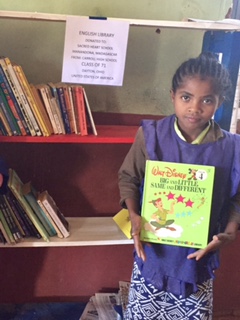
Everyone asked if I would help them learn English. Even here in a small village they see being able to speak in English as an important key to their future. With no books of any kind, teaching would be a boring task. When friends and family asked what they could send me I said, children’s books in English. Word traveled fast through my high school in Dayton, Ohio, Carroll High class of 1971. To my astonishment they pulled together, sending three huge boxes of donated books and some luxury items for me to survive my life here.
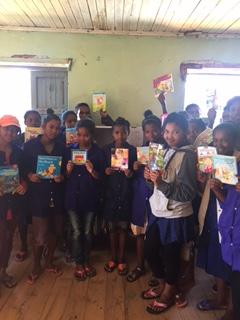
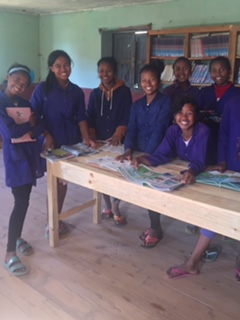
It took many months to put the library together. They have a room they call a library that no one used. It housed dozens of old text books in French. The room and books were very dirty, dusty and moldy. After months of cleaning and organizing I located a new book case and painted it the colors of my old high school colors, red, white and blue. Then I began to bring the classes up to introduce them to English books.
What I expected to happen is that they would learn new words and delight in the stories and colorful pictures, and they have. What I did not anticipate is how difficult it would be for them to understand the culture. If you are age 15 and have never seen a colorful children’s book with a fun, imaginative story this can be confusing.
They don’t really know what a train is and why Thomas the train talks and has a face. I try to explain it is not real, but then they looked confused, as if to say, if it is not real, why is it in a book. They are used to looking at old French text books for information only.
After reading about a girl who was playing with her doll house the girls asked:
What is a dollhouse?
A toy house.
Why?
To play with
To play what?
To play with the people in it, fix it up, clean it etc
Why is that fun?
Hmmm you are right, why is that fun?? It certainly did not help me grow up thinking cleaning my real house was “fun”.
They ask “what means Winnie the Pooh” as if it has a meaning. I explain that it is a name and means nothing. Then they want to know if it is a common name and if many people are named Winnie the Pooh in the United States. I tell them, no, only our bears are named “Pooh” then I have to explain why children have toy bears.
Most popular are the Car and Driver magazine, they are astonished at the photos of new cars. Basketball is played here and they also like any sports magazine with basketball players, marveling at their size and height. A bridal magazine from Ohio is a favorite of the girls. They like looking at the ads in the Dayton Daily news, looking at the price of bananas and bread fascinates them. How do I explain a picture of a loaf of bread and why we use it?
I have numbered the books 1 through 4. 1 is easy (mora) and 4 is difficult (sarotra) I call it the Malagasy decimal system of cataloging books.
What a joy it has been to see their faces as they discover new words and a new world as well. Going to the library is the highlight of their week, and it is mine as well.
We read to know we’re not alone.”
― William Nicholson, Shadowlands
“The more that you read, the more things you will know. The more that you learn, the more places you’ll go.”
― Dr. Seuss, I Can Read With My Eyes Shut
Check out a youtube by Andrew Zimmern/Madagascar. The video shows him in the same fishing town I visited the Baobab trees in and wrote about.
He eats, shops and walks down all the streets I did. I experienced most of what he did except hunting or eating the bugs he found.
Sorry the photos are a little dark.
 My Timshel by Tamara Gonzalez Oberbeck
Hi Tamara. You are truly amazing! Your Library looks beautiful!
LikeLike
That is awesome! what a difference you are making there! So proud of you!!! x
LikeLike