
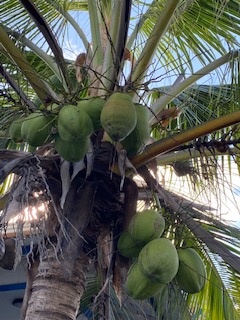
On my typical morning walk around the island, before the heat and humidity take over, I pass multiple coconut, almond, mango, breadfruit and of course banana trees. Some bananas as small as your thumb and others called plantain, triple the size of a regular banana.
We eat plantain fried, baked, or boiled. It is a tasteless carb much like our potatoes, but is a type of banana.
I have lived and worked in Honduras three different times. 1980-1983, 1985-1988 and 1999-2001. During 1985-1988 we lived in San Pedro Sula, near the city of La Lima, the headquarters for Chiquita and Dole Companies. We were involved with a Honduras project called FHIA, developed by USAID and the Honduras government. It was an attempt to put more control of the banana industry in the hands of the Hondurans.
I already know a bit about the banana history having lived and worked with experts in the industry while in San Pedro Sula. Recently a book written by Dan Koeppel “Banana-The fate of the fruit that changed the world” piqued my interest.
A banana tree is not a tree at all, it is the world’s largest herb. And we all know bananas don’t have seeds, which is what I like about the fruit. Scientist have been tweaking the genome of this plant for thousands of years to escape and/or prevent various funguses and viruses the plant is susceptible to. Grown in more than 150 countries in the world it is believed there are over 1000 varieties.
The leaves are massive and once when I was caught in a rain storm in Honduras a nice campesino with a manchette cut off a large leaf and gave it to me to use as an umbrella, it was quite effective.
The Koran writes that the fruit in the garden of Eden was a banana not an apple. They make a point that Eve was made from Adam’s rib, and is not the result of a seed from sexual reproduction. The banana is made from cuts of a grown plant and not cultivated by seed either.
The first mention of bananas is back in 500 BC in India. Fast forward to the 1400’s when Portuguese solders find them in the Canary Islands and bring them home and later in the 1800’s when Captain Cook found them in Hawaii.
In 1870 they became a delicacy for the wealthy and elite. They were hard to come by and expensive. It was considered crude and vulgar for a lady of high society to peel a whole banana and put it in her mouth to eat. No one wanted to see a woman of high society putting a whole banana in her mouth. Pause here and think about that for a moment!
PAUSE…. thinking, thinking!
Ok, hope you got the picture and inference.
The bananas were peeled and cut up into slices and delivered on a plate with a fork to be eaten. A 1899 Scientific America actually offered scholarly advice on the best techniques for peeling a banana.
By the early 1900 the banana fruit becomes the center of several central American revolutions and this banana “thing“ got messier than a lady of society eating a whole banana.
The American people start to demand more bananas and a man by the name of Baker starts the first banana importing company named United Fruit- later known as Chiquita.
Then a rival company Standard Fruit, later know as Dole starts competing and exporting.
Both company’s start buying up land in Honduras, Nicaragua and Guatemala and offer bribes to the then presidents for more land. At one point they convince the US military to intervene when the banana workers begin to protest and strike over the conditions and wages.
There were bribes, coups, military action and wars, over the rights of the banana land and exportation. Many died in the process of gaining control of the bananas.
In 1904, O.Henry published a novel called Of Cabbages and Kings, set in a country meant to resemble Honduras called Anchuria that he labeled a “banana republic” because it had a shady government and an economy that depended on bananas.
Hence the term Banana Republic. At about the same time songs were written about the banana- “Yes, I have No Bananas”, Carmen Miranda who starred in a Portuguese film called “Banana da Terra” wearing a fruit hat with bananas, and even jokes and shows involving the 3 stooges slipping on banana peels. All making the banana ever more popular.
In 1986 I had my own little shady banana scheme going on in San Pedro Sula. You see although we lived outside the gates of the world’s largest banana research and export company, we could not get a decent banana to buy. The best ones were all being exported. We were left with the rejects, not good enough for export.
The company gifted us now and then with a box of the best bananas, pineapples and strawberries being grown at the plantation since we were directly involved in the work there.
Needless to say, I had a lot of friends, I would like to report it was my charming personality but in truth it was mostly because of my contact with the banana companies. These friends would occasionally “stop by” to visit without warning. Soon they would make an excuse to go into the kitchen. “I need to wash my hands.” “Let me grab a towel for the baby, to wash his face.” But I could hear them, secretly opening cabinets, the fridge, even the freezer. Looking for my bananas. And if found they would say “Oh, Tamara you have beautiful bananas, could I have just one for the baby?” And how could I refuse a baby?
But they seldom found them. I always hid them in places they dare not look. Unless of course they had something valuable to trade at which point I would bring them out and drive a very hard bargain.
Yes, I have no Banana tree photos!
 My Timshel by Tamara Gonzalez Oberbeck
Leave a comment